Dexter’s Laboratory at 30: Why the Boy Genius Still Feels Iconic
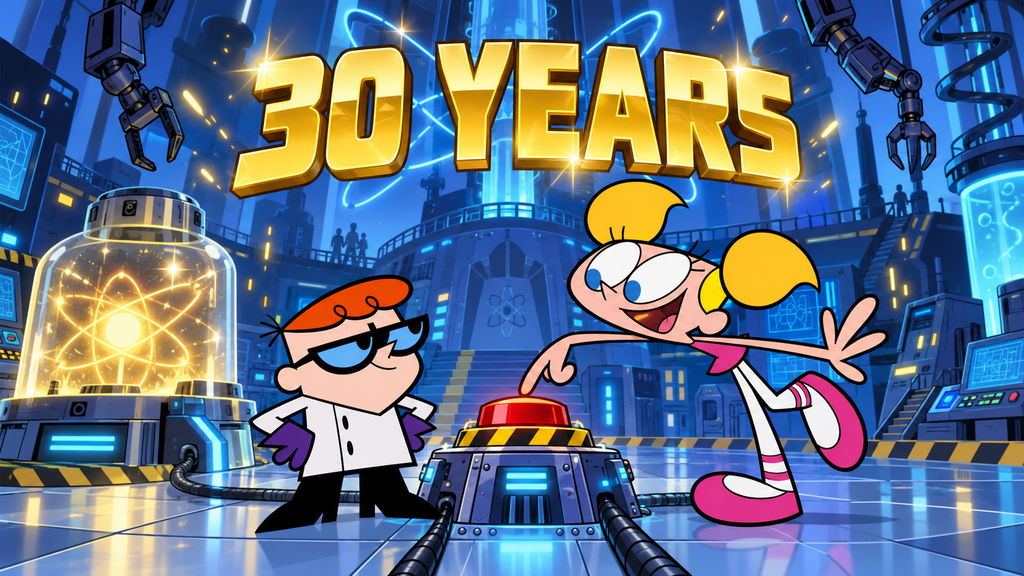
Hidden behind an ordinary bedroom was a secret laboratory filled with impossible inventions, glowing buttons, giant robots, and experiments that could change the world.
There was only one problem.
Dexter’s sister Dee Dee always found a way inside.
Thirty years after Dexter’s Laboratory became a full television series, its simple but brilliant idea still feels timeless. Dexter wanted complete control over his scientific world, while Dee Dee represented the unpredictable chaos that no machine could contain.
Their battles created some of Cartoon Network’s funniest and most memorable moments.
The Beginning of a New Cartoon Network Era
Created by Genndy Tartakovsky, Dexter’s Laboratory first appeared as an animated short before becoming a full series in April 1996.
It arrived during an important period for Cartoon Network. The channel was beginning to develop original characters and stories that could give it a unique identity.
Dexter became one of the faces of that transformation.
The show’s success helped open the door for a generation of original Cartoon Network series. Its strong visual style, unusual humor, and fast storytelling showed that television cartoons could feel experimental without becoming difficult to understand.
A child could enjoy the explosions and sibling arguments. An older viewer could appreciate the clever references, visual comedy, and absurd situations hidden underneath.
Dexter Was Brilliant but Never Truly in Control
Dexter believed that science could solve every problem.
Inside his laboratory, he built robots, traveled through time, explored space, and created machines far beyond anything the adults around him could imagine. He saw himself as a serious scientist destined for greatness.
But his greatest weakness was not a failed invention. It was his own confidence.
Dexter often created a larger disaster while trying to prevent a smaller one. His intelligence allowed him to build almost anything, but it could not always protect him from jealousy, impatience, or embarrassment.
That contradiction made him more than a stereotypical genius.
He was still a child—brilliant, stubborn, secretive, and desperate to prove that he knew everything.
Dee Dee Was More Important Than She Seemed
To Dexter, Dee Dee was an unstoppable force of destruction.
She touched buttons without asking questions, danced through dangerous experiments, and somehow entered a laboratory that was supposed to be completely hidden.
But Dee Dee was not simply there to ruin Dexter’s work.
She brought imagination and freedom into a world built around strict rules. Dexter saw machines according to their purpose. Dee Dee saw opportunities to play. Where he demanded order, she created movement.
Her famous curiosity turned every carefully controlled experiment into something unexpected.
In many episodes, Dexter’s real challenge was not defeating Dee Dee. It was accepting that he could not control everything—and that intelligence without flexibility could become its own kind of foolishness.
A Visual Style That Was Impossible to Confuse
Even a single image from Dexter’s Laboratory is easy to recognize.
The show used bold shapes, dramatic poses, sharp shadows, and exaggerated expressions. Dexter’s small body, enormous glasses, orange hair, and white laboratory coat created an unforgettable silhouette.
The laboratory itself felt enormous.
Its dark spaces, glowing screens, mechanical doors, and endless machines made it appear far larger than the family home surrounding it. It was both a childhood fantasy and a mysterious world waiting behind the bedroom wall.
The series was also influenced by the clean, graphic appearance of mid-century animation. That visual simplicity helped the action remain clear, even when the screen was filled with robots, lasers, and scientific chaos.
The Family Made the Fantasy Feel Familiar
Outside the laboratory, Dexter still lived in an ordinary suburban home.
His mother cleaned while wearing rubber gloves. His father could become completely distracted by food or another simple obsession. Neither parent seemed to understand what was happening only a few rooms away.
That contrast made the show special.
The secret laboratory represented the enormous private worlds children create inside their imagination. To the adults, Dexter was simply their unusual son. To viewers, he was running one of the most advanced scientific facilities on Earth.
Many children understood that feeling—the belief that something extraordinary could exist inside an otherwise ordinary home.
It Never Needed to Explain Everything
The show rarely worried about whether its world made logical sense.
Dexter spoke with an unexplained accent. His laboratory seemed physically impossible. Dee Dee could appear behind him no matter how strong the security became.
None of that needed an answer.
The mystery was part of the fun. The audience accepted the rules because the characters were consistent, the comedy was strong, and every episode moved with confidence.
That freedom allowed the creators to tell stories about superheroes, giant monsters, space travel, school problems, family dinners, and sibling rivalry within the same series.
Why Dexter Still Matters 30 Years Later
Many cartoons are remembered for a character or a particular joke. Dexter’s Laboratory is remembered as part of an entire era.
It represents the excitement of discovering Cartoon Network when its original identity was still being formed. Dexter, Dee Dee, and their impossible laboratory helped define what a Cartoon Cartoon could be: visually bold, strange, intelligent, and immediately recognizable.
The technology inside Dexter’s laboratory may belong to science fiction, but the central relationship remains completely familiar.
One sibling wants privacy. The other refuses to stay away.
One wants perfect order. The other brings chaos.
Thirty years later, Dexter may still believe he can finally keep Dee Dee out of his laboratory.
The rest of us already know better.

Post Comment