The Tom and Jerry Episode That Traumatized an Entire Generation
For most of us, Tom and Jerry meant laughter.
A furious chase through the house. A frying pan to the face. A perfectly timed trap that always backfired. No matter how much chaos filled the screen, everything usually returned to normal before the next cartoon began.
But one episode broke that familiar formula.
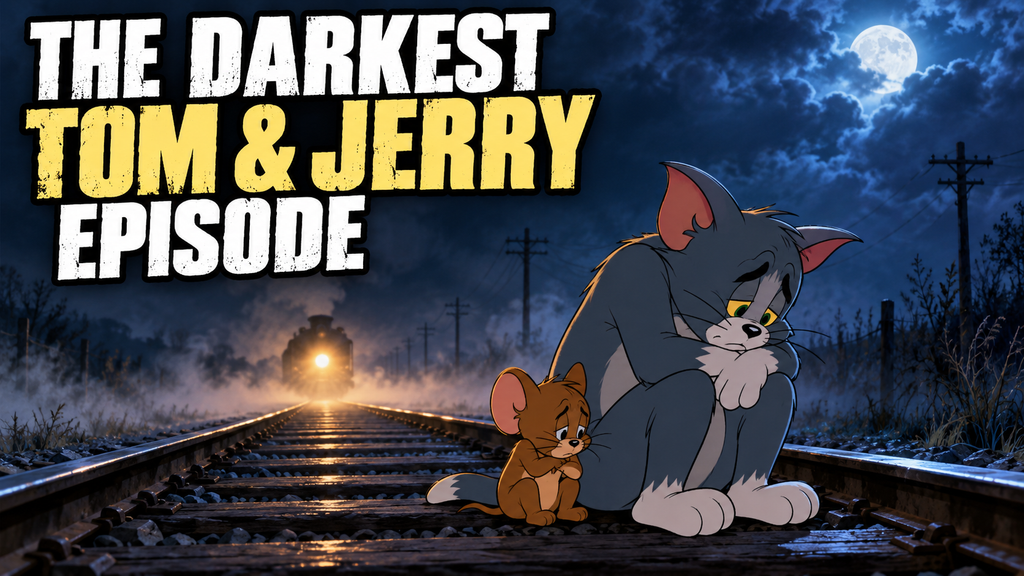
There was no triumphant ending, no final joke and no cheerful return to the chase. Instead, Tom and Jerry sat silently beside one another on a railway track as the sound of an approaching train grew louder.
The episode was called “Blue Cat Blues”, and decades later, its ending continues to disturb the people who watched it as children.
A Tom and Jerry Story Without the Usual Chase
Released in 1956, “Blue Cat Blues” begins with an image that immediately feels wrong.
Tom is sitting alone on a railway track, completely defeated. Jerry watches him from above and begins recounting the events that brought his friend to this moment.
That detail alone makes the episode unusual. Jerry rarely speaks in the classic cartoons, but here his thoughts are delivered through a sorrowful voice-over.
He explains that Tom was once happy and that the two of them had been close friends. Everything changed when Tom saw a beautiful white cat and instantly fell in love with her.
At first, it appeared that she returned his affection. But then another cat arrived.
Butch was wealthy, confident and capable of buying everything Tom could not afford. Whenever Tom presented a gift, Butch appeared with something larger and more expensive.
A flower was answered with an enormous bouquet.
A bottle of perfume was replaced by a tanker filled with it.
Even when Tom sacrificed everything to purchase a car, Butch arrived with something far more impressive.
The competition was ridiculous, but the emotions behind it were not.
Tom Loses More Than a Competition
Tom becomes so desperate to win her affection that he stops thinking rationally.
He spends everything he has. He signs away years of his life to pay for a broken-down car. He repeatedly humiliates himself, believing that one more gift might finally make him worthy of being loved.
Nothing works.
The white cat chooses Butch, and Tom watches the newly married couple drive away together.
That is the moment when the episode stops feeling like an ordinary cartoon.
In most Tom and Jerry stories, Tom survives explosions, falls and impossible injuries. Seconds later, he is ready to continue the chase.
But this time, the damage is emotional.
There is no instant recovery.
Jerry Tries to Save His Friend
Throughout the story, Jerry attempts to protect Tom from his own despair.
When Tom begins drinking, Jerry tries to take the glass away. When Tom throws himself into the water, Jerry pulls him back to safety.
For once, Jerry is not celebrating Tom’s failure.
He is worried about him.
This completely changes the relationship between the two characters. Beneath all their fighting, the episode suggests that their connection is deeper than their rivalry.
Jerry may tease Tom, trick him and occasionally make his life miserable, but he does not want to lose him.
The usual enemies suddenly appear more like two old friends who only know how to communicate through conflict.
The Ending Nobody Expected
After finishing his story, Jerry initially believes that he will never experience the same heartbreak.
He looks at a photograph of his girlfriend and describes her as loyal.
Then a car passes beneath him.
Inside is Jerry’s girlfriend with another mouse. A sign on the back reveals that they have just been married.
Jerry looks at the photograph again, devastated.
Without saying anything, he walks down to the railway track and sits beside Tom.
Neither of them moves.
The whistle of an approaching train becomes louder, and the episode fades to black.
We never see the train reach them. Their deaths are not shown or officially confirmed inside the cartoon.
But the implication was dark enough to leave generations of young viewers wondering what they had just witnessed.
Why “Blue Cat Blues” Felt So Disturbing
Cartoon violence normally feels harmless because its consequences disappear.
Tom can be flattened, burned or cut into pieces, yet we know he will return in the next scene. That unspoken rule allows us to laugh.
“Blue Cat Blues” removes that protection.
The characters are not hurt by a falling piano or another elaborate trap. They are hurt by rejection, jealousy, loneliness and hopelessness—emotions that exist outside the cartoon world.
The final scene is also unusually quiet.
There is no exaggerated reaction to tell the audience that everything is still a joke. Tom and Jerry simply sit together while the train approaches.
The absence of a punchline is what makes the ending so powerful.
It Was Not the Final Tom and Jerry Episode
One of the most widespread stories about “Blue Cat Blues” claims that it was the final Tom and Jerry episode and that the series ended with both characters dying.
That story is false.
More Tom and Jerry theatrical shorts were released after “Blue Cat Blues,” and both characters continued appearing alive in later adventures.
The episode’s ending is deliberately bleak, but it was not the conclusion of the entire series.
This misconception probably became popular because the scene feels so final. Without knowing its original release order, it is easy to imagine that the creators intended it as a permanent goodbye.
In reality, it was one unusually dark story inside a much larger collection of cartoons.
The Episode Was About More Than Heartbreak
It would be easy to describe “Blue Cat Blues” simply as a story about two characters losing their girlfriends.
But its message goes deeper.
Tom believes love must be purchased. He tries to compete with someone wealthier and slowly destroys himself in the process. Every new gift brings him more debt but never brings him closer to genuine affection.
The episode shows how comparison can turn love into obsession.
Tom is no longer trying to build a relationship. He is trying to prove that he is more valuable than Butch.
When he cannot win, he begins believing that he has no value at all.
That idea is surprisingly mature for a short cartoon released in the 1950s.
Tom and Jerry Were Never Truly Enemies
The most emotional part of the episode is not the approaching train.
It is the fact that Jerry chooses to sit beside Tom.
Jerry spends much of the story trying to save his friend. When he experiences the same heartbreak, he finally understands Tom’s pain completely.
Their suffering brings them together.
This is not necessarily a healthy or hopeful ending, but it reveals something important about their relationship. Despite every chase and every fight, neither character is truly complete without the other.
They may behave like enemies, but in their darkest moment, they refuse to leave one another alone.
Why We Still Remember It
Many people watched “Blue Cat Blues” before they were old enough to understand depression, financial desperation or emotional collapse.
They only knew that Tom looked different.
He was not angry. He was not preparing another trap. He had simply stopped fighting.
As adults, the episode feels even heavier because we can finally recognize what the characters are experiencing.
We understand the danger of comparing ourselves to someone who appears to have more. We understand how rejection can damage a person’s self-worth. And we understand why Jerry’s decision to sit beside Tom feels both loyal and deeply tragic.
“Blue Cat Blues” did not traumatize viewers because it contained the most violence.
It stayed with them because, for once, the pain felt real.
And when the screen faded to black, the cartoon offered no easy answer to make that pain disappear.

Post Comment