The Cartoon Network City That Disappeared Too Soon
The Cartoon Network City That Disappeared Too Soon
For a short period in the 2000s, Cartoon Network did something that made its characters feel more alive than ever.
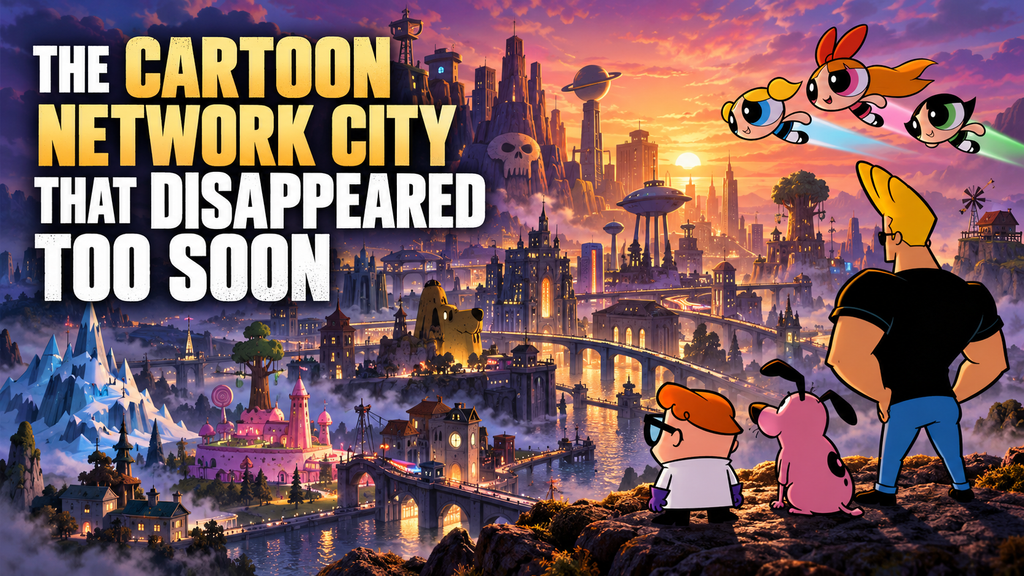
Dexter, Johnny Bravo, the Powerpuff Girls, Ed, Edd n Eddy, Courage, and dozens of other familiar faces no longer seemed trapped inside separate television shows. Between programs, they appeared to live together inside one enormous animated city.
Characters crossed paths on sidewalks, waited for public transport, visited stores, and continued with their daily lives even after their shows had ended.
This was Cartoon Network City—and for many viewers, it felt like a real place they desperately wanted to visit.
Then, almost as suddenly as it appeared, the city disappeared.
Cartoon Network Became a Shared World
On June 14, 2004, Cartoon Network introduced a major visual rebrand in the United States.
The familiar checkerboard identity was updated, along with a new slogan: “This is Cartoon Network.” But the most memorable part of the change was the collection of short animated bumpers created for the channel.
These bumpers were set inside a large CGI environment commonly remembered as CN City.
The city combined locations, buildings, vehicles, and visual elements inspired by different Cartoon Network shows. Two-dimensional characters were placed inside three-dimensional streets and environments, creating the illusion that every series existed in the same connected world.
It was more than a collection of advertisements.
It was a crossover universe shown in small pieces.
The Moments Between Shows Became Important
Television bumpers were normally simple transitions. Their purpose was to tell viewers what was currently playing or what would appear next.
CN City transformed those few seconds into something worth watching.
A familiar character might be seen walking through the city. Characters from completely different cartoons could share the same location without needing a full crossover episode. Their personalities remained recognizable, even when they appeared only briefly.
The scenes rarely required a complicated story. That was part of their charm.
They showed the ordinary moments we never saw inside the cartoons—the moments when the characters were not fighting villains, chasing one another, inventing machines, or causing chaos.
For a few seconds, viewers could imagine that these characters had lives beyond their individual shows.
Why the City Felt So Real
Every cartoon had its own art style, rules, and universe. CN City found a way to bring those differences together without completely erasing them.
The characters remained visually close to their original two-dimensional designs, while the city around them had depth, lighting, shadows, streets, and moving vehicles.
That contrast created a strange but convincing world.
It felt as if the characters had stepped out of their television screens and entered a larger reality. Somewhere beyond the frame, Dexter’s laboratory, the Powerpuff Girls’ home, and the neighborhood from Ed, Edd n Eddy could all exist within the same enormous city.
The network was no longer presented as a schedule containing unrelated programs.
It became a place.
It Created Crossovers Without Changing the Shows
Modern entertainment often builds shared universes through movies, sequels, and carefully connected stories. CN City achieved a similar feeling through short transitions that sometimes lasted less than a minute.
It did not need to explain how the characters met.
The audience simply accepted that they lived near one another.
That simplicity made the experience special. The crossovers did not interrupt the original series or force them into one complicated storyline. They existed between the shows, giving viewers just enough information to imagine the rest.
For children watching at the time, the possibilities seemed endless.
What happened when the cameras stopped following the characters? Where did they go after an episode ended? Did they recognize characters from other cartoons?
CN City quietly answered those questions: they all went back to the same world.
Why Did Cartoon Network City Disappear?
There was no dramatic final episode or official destruction of the city.
It was an on-air branding concept, and television networks regularly change their appearance to match new programming, audiences, and marketing strategies. As Cartoon Network introduced new visual identities, the CN City bumpers were gradually phased out in the United States.
The city did not receive a proper goodbye.
One day it was simply no longer part of the channel’s daily rhythm.
That may be one reason people remember it so strongly. Viewers were never given a conclusion. The characters did not leave, and the city was not shown closing down. It simply stopped appearing, leaving behind the feeling that it might still exist somewhere beyond the screen.
More Than Childhood Nostalgia
It is easy to say that people love CN City only because it reminds them of childhood. Nostalgia is certainly part of its appeal, but the concept also represented an unusually creative way to build a television channel’s identity.
The bumpers respected the characters and trusted the audience’s imagination.
They did not constantly explain what viewers were seeing. They allowed small details, unexpected meetings, and ordinary situations to make the world feel believable.
Today, television is increasingly divided between streaming platforms, separate applications, and personalized recommendations. The shared experience of waiting between programs has become less common.
CN City came from a time when even the space between cartoons could become part of the entertainment.
A City That Still Lives in People’s Memories
The original bumpers continue to be collected, uploaded, restored, and discussed online. Many viewers remember individual scenes despite not seeing them for years.
That lasting reaction reveals how successful the idea was.
Cartoon Network City made viewers believe that their favorite characters belonged to something larger. It connected different generations of cartoons and turned a television network into a living world.
The city may have disappeared from the channel, but it never completely disappeared from the people who grew up watching it.
Perhaps that is why CN City remains unforgettable.
It was not simply where the cartoons lived.
For a few moments between shows, it felt like a place where we lived with them.

Post Comment