The SpongeBob Detail Most Fans Never Noticed
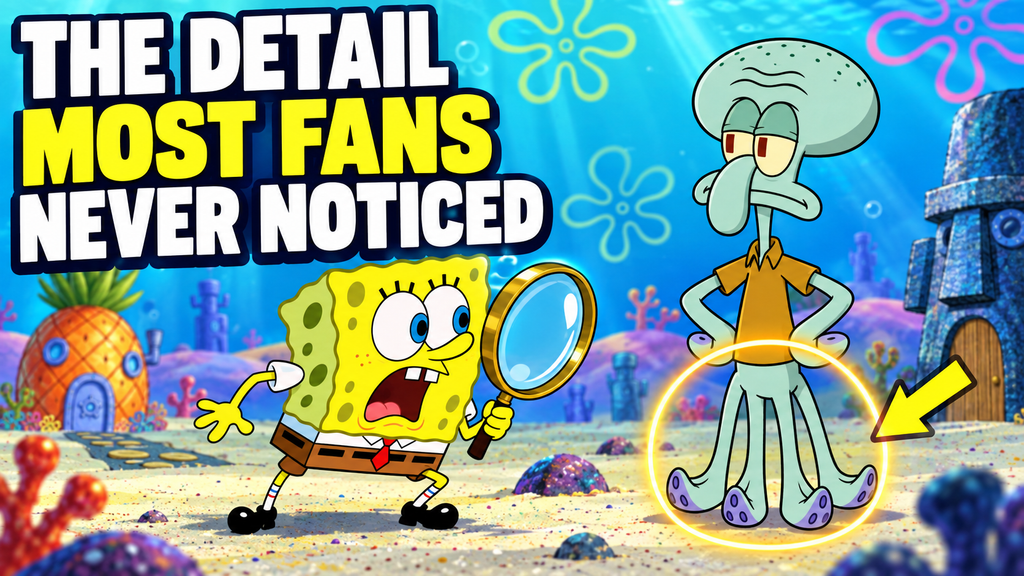
The SpongeBob detail most fans never noticed is hidden in plain sight.
For more than two decades, viewers have followed SpongeBob, Patrick, Squidward and the other residents of Bikini Bottom without questioning the strange logic of their underwater world.
A sponge lives inside a pineapple. A squirrel survives beneath the ocean in a glass dome. A crab has a whale for a daughter. Almost anything seems possible.
But one of the show’s most familiar characters has been hiding a surprising detail in plain sight.
Despite his name, Squidward is not a squid.
He is an octopus.
Squidward’s Name Has Fooled Viewers for Years
With a name like Squidward Tentacles, most viewers naturally assumed that SpongeBob’s irritated neighbor was supposed to be a squid.
However, series creator Stephen Hillenburg designed him as an octopus.
Hillenburg reportedly preferred the rounded, bulb-shaped head of an octopus because it suited Squidward’s personality. Squidward considers himself sophisticated, artistic and intellectually superior to almost everyone around him, so the large head became a visual extension of his enormous ego.
The character’s appearance contains clues.
Unlike many squid, Squidward does not have an elongated body or the pointed fins typically associated with them. His large, rounded head and flexible limbs are much closer to the recognizable shape of an octopus.
So why was he not called Octoward?
The practical answer is that the name did not sound as good. “Squidward” was more memorable and worked better with the name Edward, even if it was not biologically accurate.
Why Does an Octopus Have Only Six Limbs?
Once viewers learn that Squidward is an octopus, another question becomes impossible to ignore.
Octopuses have eight limbs.
Squidward usually appears to have only six: two that function like arms and four that support him while he walks.
This was not intended to suggest that Squidward had lost two tentacles. It was an animation decision.
Drawing and moving eight separate limbs in every scene would have made the character more complicated and time-consuming to animate. Six gave him a recognizable octopus-like silhouette without overcrowding the design.
The missing limbs demonstrate an important principle of animation: a character does not need to be perfectly realistic to communicate an idea effectively.
Squidward only needs enough octopus features for the audience to understand what kind of creature he is supposed to represent.
Ironically, the simplified design may have helped hide his real species. Because viewers saw the name “Squidward” and did not count his limbs, most never questioned whether he was actually a squid.
The Detail Makes Sense When You Know Who Created the Show
Squidward’s species was not a random mistake made by an animator unfamiliar with marine life.
Stephen Hillenburg understood the difference between a squid and an octopus.
Before entering the animation industry, Hillenburg studied marine science and worked as an instructor at the Ocean Institute in Dana Point, California. He taught visitors about tide pools and the creatures living inside them.
During that period, he created an educational comic called The Intertidal Zone. The comic used illustrated sea creatures to teach students about marine environments.
That project eventually became one of the earliest foundations for the world that would become SpongeBob SquarePants.
Hillenburg later studied experimental animation and worked on Rocko’s Modern Life. His scientific background and artistic career eventually came together in Bikini Bottom—a fictional world that deliberately mixes genuine marine knowledge with cartoon absurdity.
SpongeBob Was Originally More Realistic
Squidward was not the only character whose design changed while Hillenburg developed the series.
Early versions of SpongeBob looked more like an actual sea sponge. Real sea sponges are usually irregular, organic-looking animals rather than perfect yellow rectangles.
Hillenburg eventually realized that a common kitchen sponge better matched the personality he wanted for the character.
The square shape made SpongeBob appear innocent, neat and slightly ridiculous. It also made his silhouette immediately recognizable.
Turning a sea creature into a kitchen sponge was scientifically inaccurate, but that contrast was part of the joke. SpongeBob could still behave like an underwater animal while visually representing the household object most viewers associated with the word “sponge.”
His design therefore combined marine biology, visual comedy and personality in one simple shape.
The Other Characters Were Not Chosen Randomly
Bikini Bottom may be absurd, but its main characters were built around carefully selected sea creatures.
Patrick’s slow behavior and uncomplicated personality were connected to Hillenburg’s observations of sea stars. Although Patrick is exaggerated for comedy, his relaxed appearance fits the way many people imagine a starfish resting on the ocean floor.
Mr. Krabs was influenced partly by a manager Hillenburg knew while working at a seafood restaurant. The character combined crab-like features with the personality of a strict, money-conscious boss.
Pearl’s enormous head reflects her identity as a sperm whale. Sperm whales possess the largest brains of any living animal, contained inside their famously large heads.
Plankton’s tiny size is also essential to the joke behind his character. In real marine ecosystems, plankton are generally organisms that drift through water and are often extremely small. In the show, one of Bikini Bottom’s smallest residents has one of its largest ambitions.
Even Sandy’s presence has a certain scientific logic. A land animal cannot breathe underwater, so she survives using an air-filled suit and dome. The technology is fictional, but the basic problem it solves is real.
These details do not make SpongeBob SquarePants a science lesson. They show how Hillenburg used real knowledge as a foundation for comedy.
Bikini Bottom Works Because It Is Both Real and Impossible
The world of SpongeBob constantly breaks the laws of nature.
Characters light fires underwater. They visit beaches located beneath the sea. Snails behave like cats, worms behave like dogs and fish regularly drown.
None of this is accidental.
The show uses just enough marine reality to make Bikini Bottom feel like a functioning ecosystem, then breaks that reality whenever doing so creates a stronger joke or story.
That balance separates the series from a cartoon that simply places human characters underwater.
The residents are recognizable sea creatures. Their homes incorporate anchors, shells and other objects associated with the ocean. The scenery resembles a tide pool transformed into a town.
Underneath the surreal comedy is a world created by someone who genuinely studied and cared about marine life.
A Small Detail That Reveals the Show’s Larger Design
Learning that Squidward is an octopus may initially seem like a minor piece of trivia.
However, it reveals something important about how SpongeBob SquarePants was created.
Squidward’s species, head shape and number of limbs resulted from a combination of biology, character development and practical animation. His design was simplified, but it was not thoughtless.
The same approach can be seen throughout Bikini Bottom.
Hillenburg did not attempt to create a perfectly accurate underwater documentary. He used his scientific knowledge to decide which details should feel real and which could be transformed for comedy.
That is why the show’s world remains so memorable.
Behind the talking sponge, underwater campfires and endlessly irritated octopus is the careful work of a marine science educator who understood that learning and imagination did not have to exist separately.
Squidward was never really a squid.
The clue was visible from the beginning—we simply trusted his name more than his design.


Post Comment