Why Popeye Eats Spinach: The Truth Behind His Famous Power-Up
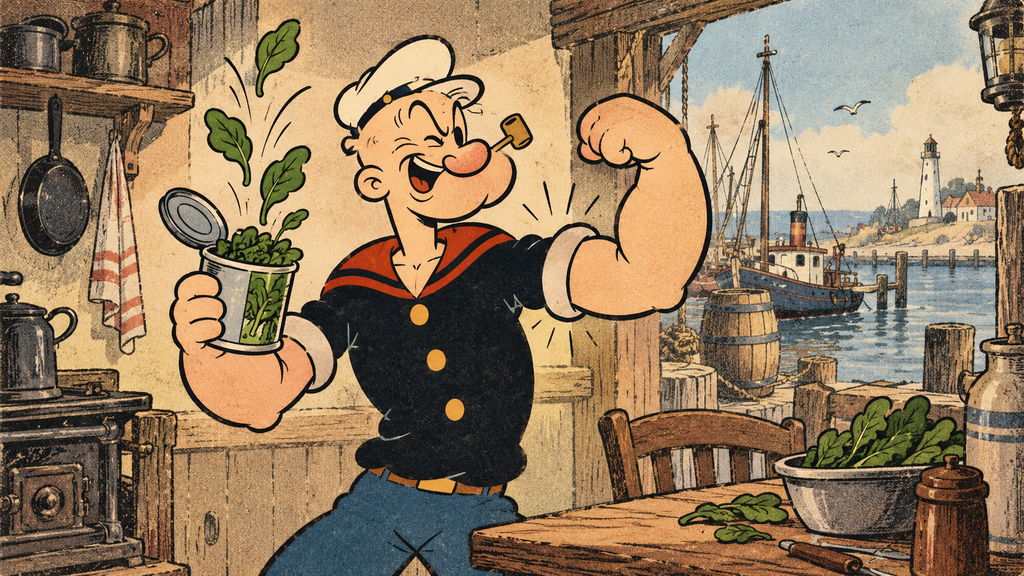
Everyone remembers the moment.
Popeye is losing a fight, a can of spinach suddenly appears, and seconds later his muscles expand as he sends his opponent flying.
The connection became so famous that generations of children grew up believing one simple idea: spinach makes you strong.
But why does Popeye eat spinach in the first place?
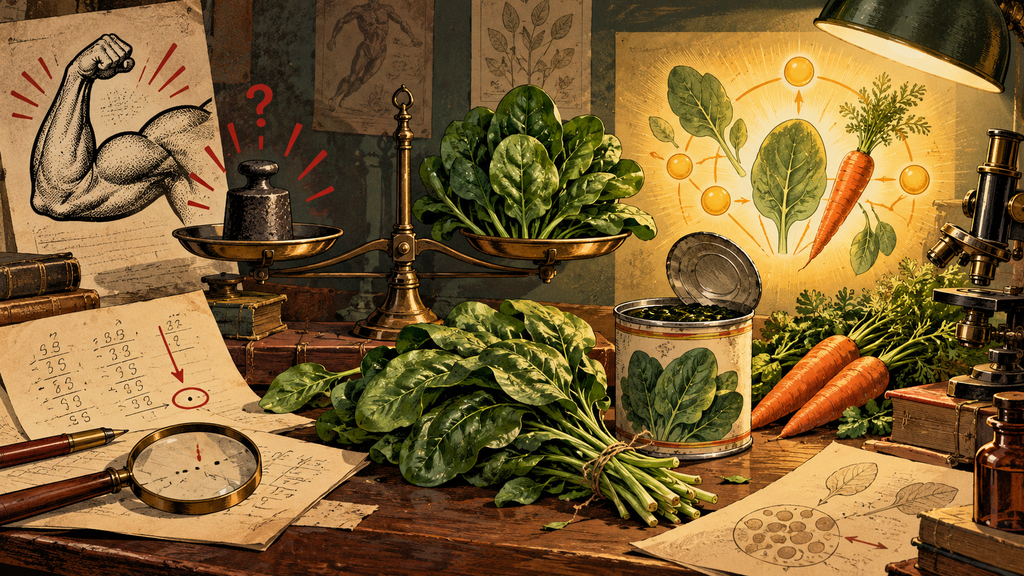
The popular explanation involves iron, a scientist and one badly placed decimal point. It is a great story—but the surviving evidence suggests that it is probably not true.
Popeye Did Not Always Eat Spinach
Popeye first appeared in E. C. Segar’s Thimble Theatre comic strip on January 17, 1929.
He was already unusually strong, stubborn and almost impossible to defeat. However, spinach was not originally presented as the source of his power.
The earliest currently documented connection appeared in a comic strip published on June 26, 1931. After escaping from jail and defeating several men, Popeye explained his strength with a simple answer:
“That’s easy, I eats me spinach!”
From that moment, spinach began becoming part of his identity—but the reason was not necessarily iron.
Popeye Actually Mentioned Vitamin A
A later comic strip gives us the clearest explanation directly from Popeye himself.
On July 3, 1932, he was shown eating fresh spinach and explaining that it made people strong and healthy because it contained vitamin A.
He never mentioned iron.
Spinach does not contain large amounts of ready-made vitamin A, but it contains beta-carotene and other compounds that the human body can convert into vitamin A.
That means Segar’s nutritional explanation was simplified, but it was not completely disconnected from reality.
The Famous Decimal-Point Story
You may have heard a different explanation.
According to a widely repeated story, a nineteenth-century scientist measured the iron content of spinach but accidentally placed a decimal point in the wrong position. The mistake supposedly made spinach appear to contain ten times more iron than it actually did.
The incorrect number was then repeated for decades, and E. C. Segar allegedly used it when giving Popeye his famous spinach habit.
There is only one problem: researchers have not found the original decimal-point mistake.
Early measurements of spinach were sometimes inaccurate, but this could have happened for several reasons. Laboratory equipment could contaminate samples, and figures for dried spinach could easily be confused with figures for fresh spinach.
When water is removed from a vegetable, its nutrients become more concentrated by weight. That alone can create a dramatic difference without anyone mistyping a number.
More importantly, no surviving statement from Segar connects Popeye’s spinach to this supposed scientific error.
The decimal-point story appears to have become popular many years after Popeye had already started eating spinach.
How Animation Turned Spinach Into a Superpower
The comic strip introduced the connection, but the animated cartoons made it unforgettable.
Popeye reached movie screens in 1933 through Fleischer Studios. The animators transformed spinach into the perfect visual power-up.
The formula was simple:
- Popeye begins a fight at a disadvantage.
- His opponent appears certain to win.
- A can of spinach arrives at the last possible moment.
- Popeye swallows it instantly.
- His muscles expand and the fight ends within seconds.
Spinach was no longer simply a healthy food he enjoyed eating. It became his transformation sequence.
The can also worked perfectly as a cartoon prop. Popeye could crush it, squeeze it, throw it into the air or fire the spinach directly into his mouth.
The repeated gag was easy to understand, visually exciting and memorable enough to survive for generations.
Does Spinach Really Make You Strong?
Spinach is nutritious, but eating one serving will not produce an immediate explosion of strength.
It contains iron, folate, vitamin K, magnesium and compounds the body can convert into vitamin A. However, the iron in spinach is non-heme iron, which is generally absorbed less efficiently than the heme iron found in meat and seafood.
Spinach also contains natural compounds that can reduce how much of that iron the body absorbs.
This does not mean spinach is useless. It can still be part of a healthy diet that supports normal muscles, bones and cardiovascular function.
It simply does not work like Popeye’s instant cartoon power-up.
Popeye Changed the Reputation of Spinach
Whether or not Popeye created a massive nationwide increase in spinach consumption is difficult to prove with reliable data.
What is certain is that he became one of the most recognizable food mascots in American culture.
Crystal City, Texas—an important spinach-growing community—even erected a monument honoring Popeye during the 1930s. A 1939 photograph preserved by the Library of Congress shows how seriously the town embraced its connection to the character.
For many children, Popeye made an unpopular green vegetable look powerful.
That cultural impact may be more important than any disputed percentage about spinach sales.
Why Spinach Was the Perfect Choice
We may never know exactly why Segar selected spinach because no definitive statement explaining his decision has been discovered.
Still, the choice made perfect sense:
- Spinach was already associated with health.
- It was inexpensive and widely available.
- Children were often encouraged to eat it.
- A can could appear instantly during a fight.
- Turning an unpopular vegetable into a source of superhuman strength was funny.
The cartoon did not need a complicated scientific explanation. It needed a recognizable object that could transform its hero in seconds.
Spinach was perfect.
The Real Answer
Popeye probably does not eat spinach because a scientist misplaced a decimal point.
The surviving comic strips show that spinach became connected to his strength in 1931. When Popeye later explained its benefits, he referred to vitamin A—not iron.
Fleischer Studios then transformed the idea into one of animation’s most famous recurring scenes.
The science myth arrived later.
Spinach may not send villains flying through walls, but Popeye turned it into something even more powerful: a symbol recognized around the world.



Post Comment