Why Snoopy Was Never Just a Dog
Some characters make us laugh. Others stay with us because, beneath their simple appearance, they understand something deeply human.
Snoopy has always done both.
At first glance, he is Charlie Brown’s black-and-white beagle—a dog who sleeps on top of his doghouse, waits impatiently for supper, and spends time with a tiny yellow bird named Woodstock. But Snoopy was never limited by what the world expected him to be.
Inside his imagination, he could become anyone.
From an Ordinary Dog to a World of His Own
When Snoopy first appeared in Peanuts in 1950, he behaved much more like a normal dog. He walked on four legs, played fetch, and had not yet developed the extraordinary inner world that would later define him.
Over time, Charles M. Schulz allowed Snoopy to stand on two legs, communicate through thought, and take on an increasingly independent personality. He was no longer simply Charlie Brown’s pet. He became a character with dreams, disappointments, confidence, fears, and an identity entirely his own.
That transformation made Snoopy different from almost every other cartoon animal.
He did not need to speak aloud for readers to understand him. His expressions, movements, and thoughts revealed a complete personality—one that often appeared more confident and emotionally complex than the humans around him.
His Imagination Was More Than a Joke
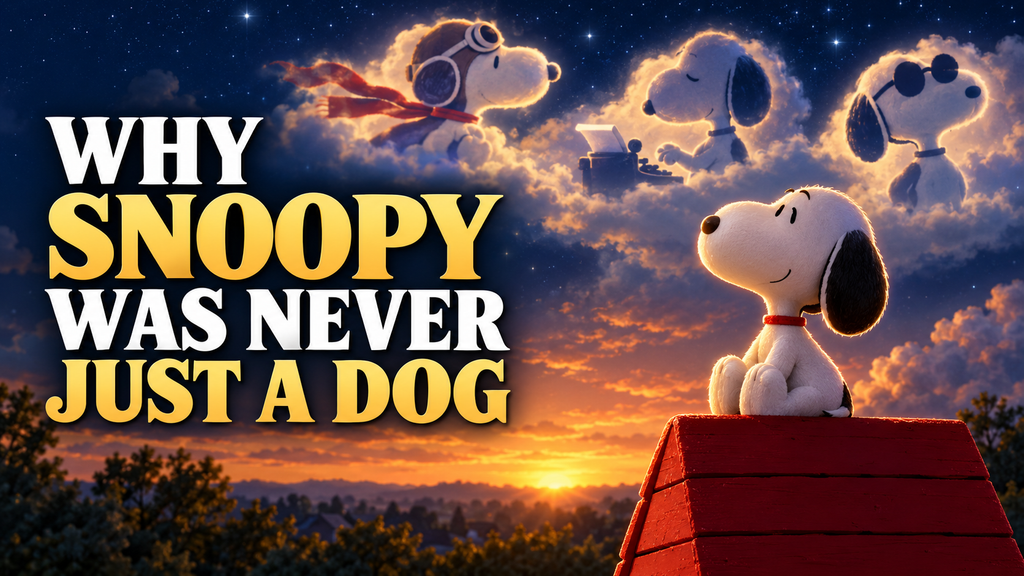
Snoopy could turn the roof of his doghouse into almost anything.
In one moment, it became a battlefield in the sky, where he imagined himself as the World War I Flying Ace pursuing the Red Baron. In another, it became the desk of the World-Famous Author, endlessly working on the opening of his great novel.
He could become Joe Cool, a famous surgeon, an athlete, an adventurer, or any other character he needed to be.
These fantasies were funny, but they also revealed something important: Snoopy refused to let reality decide the limits of his life.
The world might see a small beagle sitting on a doghouse. Snoopy saw a pilot inside a Sopwith Camel, a novelist creating a masterpiece, or the coolest student on campus.
His circumstances remained the same, but his imagination changed everything.
Snoopy Could Escape Without Running Away
The children in Peanuts regularly faced rejection, loneliness, insecurity, and disappointment. Charlie Brown worried about failure. Lucy tried to hide her vulnerability behind confidence. Linus searched for safety and understanding.
Snoopy faced the same imperfect world, but responded differently.
Whenever ordinary life became too small or difficult, he created another one.
His imagination was not simply a refusal to face reality. It gave him a way to experience courage, excitement, and purpose. Even when his imaginary missions ended badly, he could climb back onto his doghouse and begin another adventure.
That is one reason adults may understand Snoopy differently than children do.
As children, we see a funny dog pretending to fly an airplane. As adults, we may recognize the familiar desire to escape pressure for a moment—to become someone braver, freer, or more successful inside our own thoughts.
He Could Be a Hero and Still Need Comfort
Snoopy often acted independent. He could appear dramatic, stubborn, proud, and completely convinced of his own greatness.
Yet beneath that confidence was a softer side.
No matter how far his imagination carried him, he still returned to familiar comforts: his doghouse, Woodstock, suppertime, and the round-headed kid who cared for him.
This contrast made him feel real.
He could imagine himself as a fearless hero while still becoming excited about a bowl of food. He could act as though he needed nobody, yet remain deeply connected to the people and friends around him.
Snoopy showed that independence and attachment do not have to cancel each other out. We can dream of another world while still needing a place that feels like home.
Why Snoopy Still Matters
Snoopy has lasted for generations because he represents more than childhood nostalgia.
He represents the private world that every person carries inside.
Most of us cannot transform a doghouse into an airplane, but we understand the feeling behind it. We remember inventing adventures from ordinary places. We know what it is like to imagine a different version of ourselves when real life feels repetitive, disappointing, or too limited.
Snoopy reminds us that imagination is not something we have to leave behind when childhood ends.
It can be a source of humor, courage, comfort, and survival.
Perhaps that is why Snoopy was never just a dog. He was a dreamer living in an ordinary world—and refusing to let that world tell him who he was allowed to become.

Post Comment