9 Simpsons Details You Can Only See by Pausing the Episode
9 Simpsons Details You Can Only See by Pausing the Episode
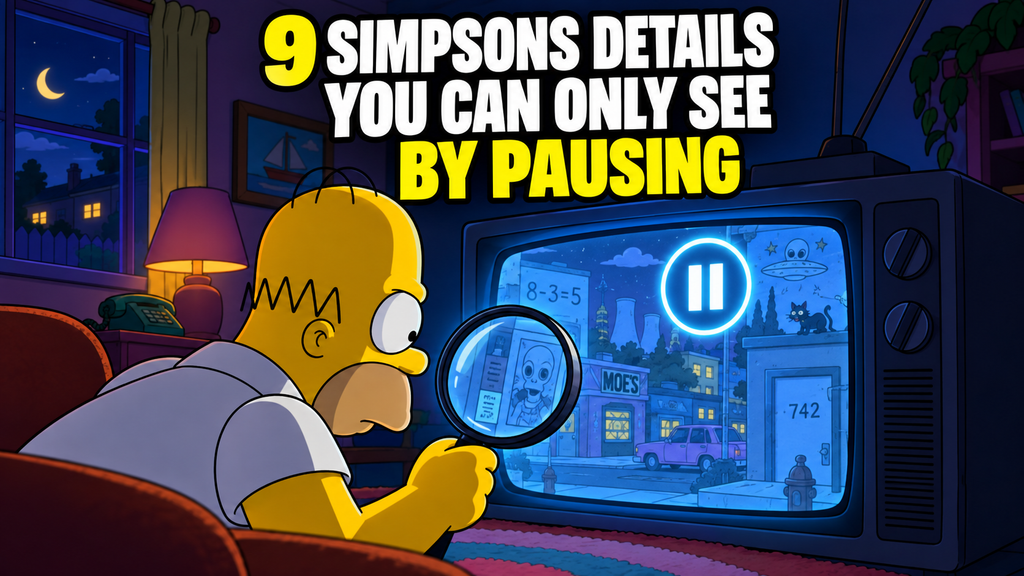
The Simpsons has never treated its backgrounds as empty space.
A sign that appears for two seconds may contain an extra joke. A random number may reference advanced mathematics. Even Homer’s head includes a hidden signature that has been visible since the character was created.
These details helped create what the writers called the “freeze-frame gag”—a joke designed for viewers willing to pause, rewind and inspect the screen.
Here are nine Simpsons details that are almost impossible to appreciate without pressing pause.
1. The Mysterious Price Attached to Maggie
During the original opening sequence, Maggie is accidentally scanned at the supermarket checkout. For only a brief moment, the register displays:
$847.63
The number has inspired one of the show’s longest-running pieces of trivia. It is frequently claimed that $847.63 represented the average monthly cost of raising a baby in the United States when the series began.
However, that explanation has never been confirmed by a reliable original source.
The number itself is real, but its supposed meaning may be a fan explanation that became accepted through repetition.
When the opening sequence was redesigned in 2009, the register showed $243.26 before Maggie was scanned and $486.52 afterward—suggesting that adding a baby doubled the family’s grocery bill.
2. The Real Joke Behind Sneed’s Feed & Seed
In the episode “E-I-E-I-(Annoyed Grunt),” Homer visits a farming supply store called:
Sneed’s Feed & Seed
Underneath the name, a smaller sign reads:
Formerly Chuck’s
At first, it looks like an unnecessary piece of background information. But the main store name uses three words that rhyme: Sneed, Feed and Seed.
The smaller sign invites the viewer to imagine what the store’s products might have been called when the owner was named Chuck.
The show never says the answer aloud. The joke exists entirely on the sign, allowing it to pass by many viewers unnoticed.
It became one of the show’s most discussed—and most easily missed—background jokes.
3. Matt Groening’s Initials Are Hidden in Homer’s Head
Homer carries the signature of his creator everywhere he goes.
Viewed from the correct side, the two curved lines above Homer’s ear resemble the letter M. His ear was originally drawn to resemble the letter G.
Together, they form M.G. — Matt Groening.
The detail became less obvious as other animators standardized Homer’s appearance, but Groening still emphasizes the G-shaped ear when drawing Homer himself.
It is a clever signature hidden inside one of the most recognizable character designs in television history.
Once you notice it, Homer’s profile never looks quite the same again.
4. Homer’s Email Address Was Real
In “The Dad Who Knew Too Little,” Homer gives private detective Dexter Colt his email address:
It sounds exactly like the kind of address Homer would create, but the joke went further than the episode.
Writer Matt Selman registered the address before the episode aired. Curious fans who paused the scene and sent messages actually received replies written in Homer’s voice.
The account reportedly filled with messages almost immediately after the broadcast.
This transformed a tiny on-screen detail into an interactive Easter egg. Viewers who paid attention were briefly able to communicate with Homer Simpson outside the show.
5. Homer Nearly Calculated the Higgs Boson
In “The Wizard of Evergreen Terrace,” Homer attempts to become an inventor and fills a blackboard with complicated equations.
One of them approximates the mass of the Higgs boson—a fundamental particle that scientists would not experimentally confirm until 2012, fourteen years after the episode aired.
This was not a supernatural prediction.
The equation was created with help from people who genuinely understood physics. Several members of The Simpsons writing staff had strong backgrounds in mathematics, computer science and related fields.
The result was an advanced scientific reference placed behind Homer for only a few seconds.
Most viewers saw meaningless symbols. Physicists saw that someone in the writers’ room knew exactly what they were doing.
6. The Equations That Almost Broke Fermat’s Last Theorem
The show also hid two mathematical traps for viewers with calculators.
In “Treehouse of Horror VI,” the equation
1782¹² + 1841¹² = 1922¹²
briefly appears in the three-dimensional world entered by Homer.
Another supposed solution appears on Homer’s blackboard in “The Wizard of Evergreen Terrace”:
3987¹² + 4365¹² = 4472¹²
If entered into an ordinary calculator, these equations may appear correct because the numbers are enormous and the display rounds the results.
But both are carefully constructed near misses.
If either equation were truly correct, it would contradict Fermat’s Last Theorem. The writers deliberately selected numbers capable of fooling standard calculators and confusing mathematically curious viewers.
The joke is not simply that Homer wrote an equation. The calculation itself is the punchline.
7. Lisa’s Book Contains One of Mathematics’ Most Beautiful Equations
In “MoneyBart,” Lisa studies several books while attempting to manage Bart’s baseball team through statistics.
One cover briefly displays:
eⁱᵖ + 1 = 0
This is Euler’s identity, an equation famous for connecting five fundamental mathematical constants: zero, one, e, i and pi.
To most viewers, it appears to be another piece of technical decoration surrounding Lisa.
To mathematicians, it is one of the most elegant equations ever written.
The episode never stops to explain it. Understanding the reference is a reward reserved for viewers who pause the screen—or already recognize it immediately.
8. All Three Stadium Numbers Have a Secret Meaning
In “Marge and Homer Turn a Couple Play,” the stadium’s Jumbo-Vision screen asks the audience to guess the attendance.
The three options are:
- 8,128
- 8,208
- 8,191
They look like randomly selected numbers, but each was chosen for a mathematical reason.
8,128 is a perfect number because its divisors add up to the number itself.
8,208 is a narcissistic number because each of its digits raised to the fourth power adds back up to 8,208.
8,191 is a Mersenne prime—a prime number that can be expressed in the form 2ᵖ − 1.
The joke occupies only a small part of the screen and has no importance to the episode’s story. It exists purely for the tiny percentage of viewers who might pause and investigate.
9. The Springfield Googolplex Is a Mathematical Joke
Springfield’s movie theater is called the Springfield Googolplex.
The name sounds like a playful version of “multiplex,” but it contains another mathematical reference.
A googol is the number 1 followed by 100 zeros. A googolplex is vastly larger: one followed by a googol zeros.
The joke appeared years before Google became the world’s dominant search engine. Google’s name was also inspired by the word googol, while its headquarters later became known as the Googleplex.
The Springfield theater’s name is therefore not a reference to Google. It is an older mathematics joke that became even more interesting as technology changed around it.
The Background Was Never Empty
These details explain why The Simpsons became one of the first television shows fans repeatedly paused and analyzed.
The writers understood that a joke did not need to be noticed by everyone. Some could exist for mathematicians, others for attentive fans, and some simply for the person who happened to freeze the episode at exactly the right moment.
That extra effort made Springfield feel larger than the story happening in the foreground.
Even after watching an episode several times, there may still be another equation, sign or secret waiting in the background.


Post Comment