9 Things Only Adults Notice in Ed, Edd n Eddy
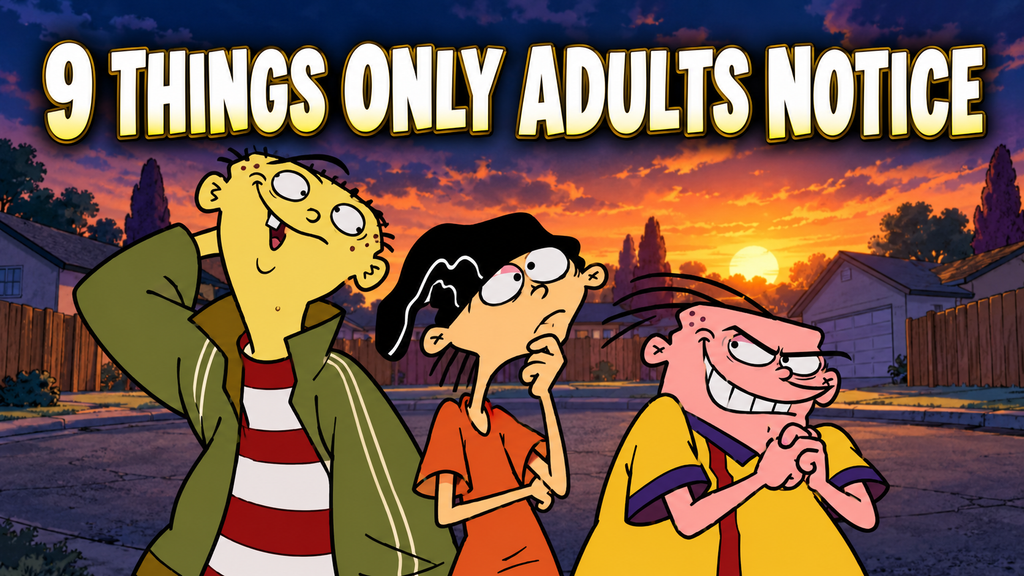
As children, we watched Ed, Edd n Eddy for the ridiculous scams, enormous jawbreakers, and complete chaos of the cul-de-sac.
But watching the series again as an adult feels surprisingly different.
Behind the strange sound effects and impossible cartoon violence is a story about three social outsiders trying to survive childhood. The characters worry about popularity, rejection, demanding parents, loneliness, and whether they will ever truly belong.
Here are nine things about Ed, Edd n Eddy that become much clearer when you watch it as an adult.
1. The Scams Were Never Really About Jawbreakers
Nearly every Eddy scheme begins with the same goal: make enough money to buy jawbreakers.
As children, that motivation seemed perfectly reasonable. Jawbreakers were the greatest possible reward, and no plan was too ridiculous if it could earn the Eds a few quarters.
But Eddy does not only want candy. He wants attention, influence, and respect.
Every new scam gives him an opportunity to become the most important person in the cul-de-sac. He is not simply selling something—he is trying to prove that the other children need him.
The jawbreakers are the reward we can see. Acceptance is the reward Eddy is actually chasing.
2. Eddy’s Confidence Is Mostly an Act
Eddy behaves as if he is smarter, cooler, and more experienced than everyone around him.
He constantly talks about his older brother, makes impossible promises, and acts like every failed plan was someone else’s fault. As children, we simply saw him as loud and selfish.
As adults, it becomes easier to recognize his behavior as insecurity.
Eddy desperately controls how other people see him because he is afraid they will discover how powerless he truly feels. His exaggerated confidence is a performance designed to keep anyone from seeing the frightened child underneath it.
That does not excuse the way he treats his friends, but it makes his behavior more understandable.
3. Double D Is Carrying an Enormous Amount of Anxiety
Double D is polite, intelligent, organized, and responsible. Compared with Ed and Eddy, he often appears to be the sensible member of the group.
Look more closely, however, and he seems constantly exhausted by the pressure of doing everything correctly.
He worries about rules, cleanliness, schoolwork, manners, safety, and disappointing his parents. Even minor disorder can make him panic. His politeness sometimes feels less like confidence and more like fear of making a mistake.
His parents communicate with him largely through written notes, usually containing instructions and chores. They are present in his life, but rarely seem emotionally available.
As an adult, Double D no longer looks like a child who simply enjoys following rules. He looks like a child who believes perfection is the safest way to avoid disapproval.
4. Ed Uses Imagination to Escape
Ed may not understand what is happening around him, but he possesses the richest imagination of anyone in the cul-de-sac.
Monster movies, comic books, aliens, and imaginary adventures constantly shape the way he sees the world. When reality becomes unpleasant, Ed transforms it into something exciting that he can understand.
His home life also appears far from perfect. Sarah regularly controls and insults him, while Ed is expected to tolerate her behavior. Yet he rarely stays angry for long.
His imagination protects his happiness. Ed survives uncomfortable situations by entering a world where everything can become a monster movie and every ordinary object can begin an adventure.
What appeared to be foolishness when we were children can look like an emotional survival mechanism when we are adults.
5. The Missing Parents Make the Cul-de-Sac Feel Different
Adults are almost completely absent from the world of Ed, Edd n Eddy.
We occasionally see evidence that parents exist—notes, voices, shadows, punishments, or a hand entering the frame—but the children usually face their problems alone.
When we were young, that absence created freedom. The cul-de-sac felt like a place where summer could continue forever and children could build anything without adult interference.
Watching as an adult, the same world can feel strangely lonely.
The children destroy houses, disappear for hours, fight, experience humiliating failures, and deal with complicated emotions without an adult arriving to help them.
The parents may remain outside the frame, but their expectations and decisions still influence almost every child.
6. The Cul-de-Sac Has Its Own Social Hierarchy
The neighborhood is a miniature society with its own rules.
Kevin has confidence and social power. Nazz receives attention without having to ask for it. Rolf has a strong identity and family tradition. Sarah can control Ed through fear, while Jimmy often survives by staying close to her.
Jonny and Plank exist on the edge of the group, but even Jonny is sometimes accepted more easily than the Eds.
At the bottom are Ed, Double D, and Eddy. They are invited when the other children need something, but they are rarely trusted.
Eddy’s scams usually make their reputation worse, creating a painful cycle: the Eds want acceptance, they use another dishonest plan to get it, the plan fails, and the neighborhood rejects them again.
Their friendship survives because each of them understands what it feels like to remain outside the group.
7. Some Jokes Feel Much More Uncomfortable Now
The series uses exaggerated behavior and physical comedy, but certain situations look different through adult eyes.
The Kanker sisters repeatedly chase the Eds, ignore their objections, and force unwanted affection on them. The show presents these encounters as chaotic comedy, but an adult viewer is more likely to notice how often the boys’ boundaries are completely ignored.
The same applies to the constant humiliation, manipulation, and violence between the neighborhood children.
This does not mean the series can no longer be enjoyed. It shows how our understanding of boundaries and relationships changes as we grow older.
As children, we noticed the chaos. As adults, we notice who is uncomfortable inside it.
8. Even the Animation Reflects Their Unstable World
The outlines in Ed, Edd n Eddy rarely remain still. They shake, wobble, and seem filled with nervous energy.
That visual style perfectly matches the characters.
Nothing in their world feels completely stable. Eddy is always planning his next move, Double D is always anticipating a disaster, and Ed is mentally living inside another reality.
The hand-drawn imperfections make the cul-de-sac feel alive in a way that cleaner animation might not. Every fence, house, and character appears ready to explode into chaos.
It is not simply a strange artistic choice. It visually captures what childhood can feel like: energetic, awkward, unpredictable, and slightly out of control.
9. The Finale Changes the Way We See Eddy
The biggest emotional revelation arrives in Ed, Edd n Eddy’s Big Picture Show.
Throughout the series, Eddy describes his older brother as an impressive and powerful figure. He uses stories about him to frighten others and strengthen his own reputation.
When his brother finally appears, the truth is painful.
Instead of protecting Eddy, he humiliates and physically hurts him in front of everyone. Eddy finally admits that the stories were lies created to make people respect him.
For the first time, the neighborhood children see the fear hidden behind his personality.
The scene does not magically erase every cruel or selfish thing Eddy has done. But it explains why he spent so much time pretending to be someone stronger.
His obsession with status was not only greed. It was a frightened child copying the person who had taught him what “strength” looked like.
The Show Was Always About Growing Up
Ed, Edd n Eddy was never only a cartoon about three boys trying to buy candy.
It was about the strange experience of growing up: wanting independence while still needing protection, trying to impress people who might reject you, and hiding insecurity behind whatever personality helps you survive.
Ed escapes into imagination. Double D searches for safety in rules. Eddy creates a louder and more powerful version of himself.
Together, they build inventions, destroy the neighborhood, argue constantly, and remain friends even when nobody else wants them around.
As children, we laughed at their failures.
As adults, we finally understand what they were trying to find.
They wanted what almost every child wants—to feel accepted somewhere.
What did you notice about Ed, Edd n Eddy only after watching it as an adult?

Post Comment